
On Wednesday , 8 April, Israel expanded its kill zone beyond what had been known as the ‘safe’ areas north of Beirut’s suburban south. I talked to a doctor at the American University Hospital who told me his emergency room was treating four hundred patients wounded in the bombing. Four had died. I passed the hospital, where families outside were waiting for the medical staff’s reports. By the evening, the Health Ministry put the death toll at 182, already a day’s record for the round of fighting that began on 2 March, later raising the total to more than three hundred. Among the dead was a young man who worked in the Thai restaurant round the corner from my house. His family, like so many others, is in mourning. The last five weeks of Israel-Hizbullah warfare have produced more than five thousand Lebanese casualties.
When I walked home from dinner at the end of this worst day in this latest war, our western half of the city looked pretty much as it does in periods of peace: cafés filled with families having coffee or ice cream, shops open and brightly lit, boys kicking footballs on forecourts, bins overflowing with rubbish, babies in pushchairs rolled along broken pavements, music blaring from bars and men lugging plastic bags of groceries from Spinneys supermarket. It had been a long day of fear, not knowing where the Israeli jets would strike next.
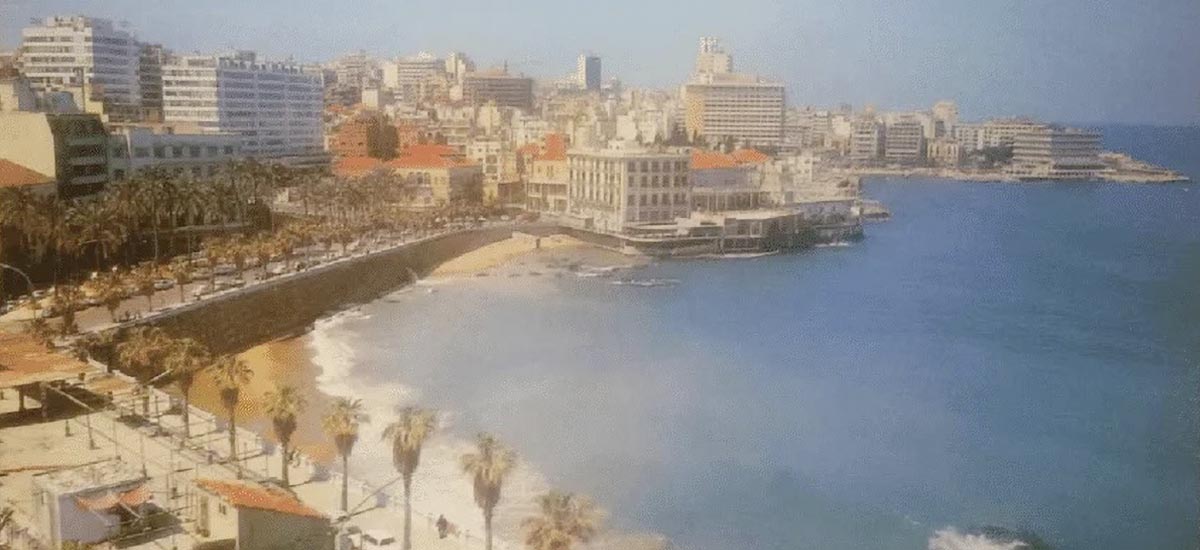
I went home to sleep, but that wasn’t the way my days in troubled times here used to end. When war kicked off in Lebanon in 1975, the foreign press corps congregated on most evenings in the bar of the Hotel Saint Georges. Over the barman Ali Bitar’s martinis and other concoctions, we compared impressions of our daylight excursions to the fluctuating frontiers between Beirut’s mutually hostile neighbourhoods. Our dispatches filed by telex, we relaxed in leather armchairs, well out of mortar range, or so we imagined, and took counsel from the impeccable concierge, Mansour Breidy. We also garnered what gossip we could from politicians, bankers, arms dealers and oilmen. It was a rare correspondent who turned up in anything less than jacket and tie. We took consolation in the calming panorama of Saint George Bay and talked ourselves into somnolence in preparation for the morning’s savagery.
As a novice freelance among legendary correspondents from the world’s major newspapers, wire services and television networks, I knew my place: listen, observe and never pontificate to elders scarred from wars in Palestine, Korea, Malaya, Suez, Belgian Congo, Indochina, Algeria and a dozen other colonial battlegrounds familiar to me only from history books. One or two had fought in or covered the Spanish Civil War and the Normandy landings. Rumour had it that a few drew second salaries from the CIA, MI6 or the KGB. The epoch of celebrated reporter-spies had, however, ended ten years before my initiation into the scribbling confraternity: in January 1963, Kim Philby, then correspondent for the Observer and the Economist as well as the Kremlin’s top agent in British intelligence, defected on a freighter from Beirut harbour to Moscow. It was in the elegant surroundings of the Saint Georges that Philby had entertained his mistress, thus declaring to surprised colleagues his liaison with the wife of his opposite number in journalism and espionage, the New York Times’s man in Beirut, Sam Pope Brewer.
Set back from the shore behind the Saint Georges loomed a cluster of its less exalted competitors, Le Vendôme, the Palm Beach, the Excelsior and the garish Phoenicia Intercontinental, where aquarium-style windows behind the bar afforded drinkers visions of swimmers cavorting in the pool. The ‘hotel district’ ceased to function towards the end of 1975, when it became the front line. Christian snipers took up positions on the upper floors of the hideous new Holiday Inn to sight and murder my neighbours. Palestinian commandos, the backbone of what was then an alliance of Sunni Muslim and leftist factions calling itself the Lebanese National Movement (LNM), expelled the Christian militias from the western half of the city, gutting, looting and burning as they went. Jonathan Randal of the Washington Post, the only one of us to see the inevitability of civil war, evacuated the Saint Georges to take refuge in our new press corps HQ, the Hotel Commodore. Another Commodore arrival was Rob Warden of the Chicago Daily News, rescued from the Palm Beach with his wife and children in an armoured personnel carrier. The Commodore, less graceful but just as functional as the Saint Georges, was safely tucked away in the urban morass of what we had begun calling ‘Muslim West Beirut’. Saint Georges exiles packed the Commodore’s circular bar sans jackets and ties, yet still flush with employers’ funds to supply one another with copious quantities of alcohol.
This was the era of the journalistic raconteur, satirised by Evelyn Waugh in Scoop forty years earlier, whose favoured sagas involved the finagling of expenses. A Newsweek colleague of mine used to say: ‘I love doing expenses. It’s the only chance I get to write fiction.’ My favourite tale, which I recall hearing from Donald Wise, a courtly former Suffolk Regiment officer who became a correspondent for the Daily Express and later the Daily Mirror, involved a British reporter in Cairo during the brief lifetime of the United Arab Republic of Egypt and Syria. The reporter was submitting countless receipts for lunches and dinners with a valued source, ‘Syrian diplomat Marwan Badawi’. As the cost of entertaining Mr Badawi exceeded even Fleet Street’s generous limits, a bookkeeper in London cabled Cairo: ‘No Badawi listed on Syrian diplomatic register. Please explain.’ The correspondent fired back: ‘Man must be an imposter. Will never deal with him again.’
Read the full diary article in London Review of Books.
Main image: 1970s Postcard showing the bay of Saint Georges; New Royal Hotel in the foreground, and the Saint Georges Hotel in the background.


