Category Archives: syria

The Epic Story of the Little City That Cast Off Assad

“Manbij. May God protect it,” the great traveler Ibn Jubayr of Valencia wrote in June 1184. “Its skies are bright, its aspect handsome, its breezes fragrant and perfumed, and while its day gives generous shade, its night is all enchantment.” These raptures eluded me when I visited the city 800 years later, in 1987, and wrote, “It was a dull, lifeless place. Either it had lost its glory, or Ibn Jubayr, like many travelers before and since, had exaggerated: Manbij was, simply, a dump.”

But “Days of Love and Rage,” the journalist Anand Gopal’s epic tribute to Manbij’s population during Syria’s 14-year civil war, forces me to recant. The heroic beauty of the city’s people, as Gopal portrays them, struggling for freedom with its attendant glories and travails more than compensates for the eyesore that is its motley collection of concrete hovels and Baath Party monstrosities.

There have been many books about Syria since the earliest days of unrest in 2011, but the closest kin to “Days of Love and Rage” is “Homage to Catalonia,” George Orwell’s indelible 1938 portrait of the fractious partisans struggling to save the Spanish republic from dictatorship. Like Orwell’s masterpiece, Gopal’s account is destined to stand out as the definitive text of the war.

Gopal, a contributing writer for The New Yorker and the author of a similarly rich telling of America’s misadventures in Afghanistan, “No Good Men Among the Living,” labored on this book for eight years. With the help of a research team that comprised half a dozen locals — “all protagonists of the revolution in Manbij,” he writes — Gopal collected 2,000 interviews, watched hundreds of on-scene wartime videos and read thousands of texts to tell the story of six ambitious rebels in a remote provincial town that even many Syrians had not heard of until war and revolution engulfed it.

Continue reading →
A History of Modern Syria — the people at the heart of their own story

Daniel Neep’s excellent account corrects the traditional narrative to show a nation surviving and resisting the powers that have vied to dominate it.

Syria is as ancient, and as complex, as civilisation itself. Lying between antiquity’s great empires of Egypt and Mesopotamia, it functioned as a bridge, sometimes a wall, between them. Rarely a conqueror, it adapted over millennia to invaders from all points on the compass: Egyptians, Sumerians, Hittites, Babylonians, Persians, Greeks, Romans, Byzantines, Arabs, Crusaders, Mongols, Turks and French.

All left indelible marks despite their ephemeral presence. On seeing Syria’s historic capital, Damascus, in 1867, Mark Twain reflected, “She has looked upon the dry bones of a thousand empires, and will see the tombs of a thousand more before she dies. Though another claims the name, old Damascus is by right the Eternal City.”

It was only in 1946 that Syria, albeit in truncated form, governed itself after 26 years of French imperial rule. Its freedom of action remained provisional while outsiders — the US and Soviet Union on the global stage, Egypt and Hashemite Iraq within the Arab region — vied to dominate it. The struggle continues today between Turkey and Israel, whose armies occupy respectively the north and the south.

Daniel Neep’s excellent, comprehensive history of “modern” Syria corrects the traditional narrative of a passive Syria by placing its people at the heart of their story. As well as considering “the usual suspects of European colonialism, American imperialism and Soviet expansionism”, he also looks to “seemingly impersonal economic currents” that have played “a crucial yet often overlooked role in remaking modern Syria”.

His account begins in the mid-19th century, during what Turkish historian Selim Deringil calls “the Ottoman twilight”, when sultans in Constantinople grappled with modernising their empire to preserve it from European encroachment…

Continue reading →
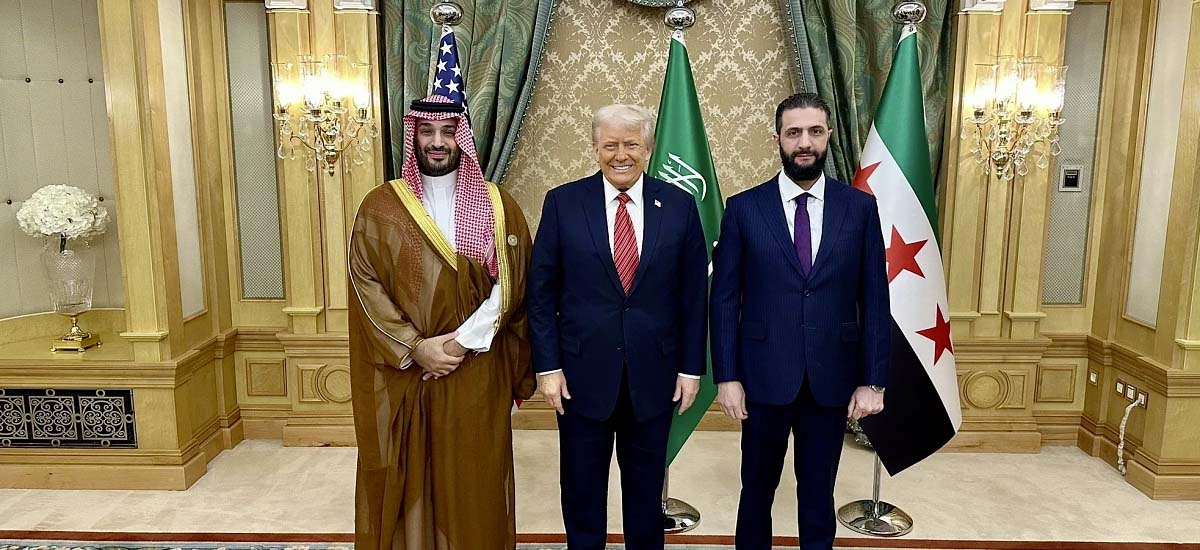
U.S. President Donald Trump with new Syrian President Ahmad al-Sharaa

In the “New Syria,” violence and high hopes

Since I left Syria last January, Alawi and Christian friends have sent me almost daily messages about killings, beatings, house break-ins, threats and intimidation.

When the dictator was overthrown, Syrians hailed the new leader with such fervor that they lifted him in his car and carried him shoulder-high through the streets of Damascus. Men beating their chests chanted the old Arabic oath of fealty, “With our souls, with our blood, we will sacrifice for you!”

That momentous event occurred, not at the end of last year when Bashar al Assad fled to Moscow, but in November 1970 when Bashar’s father, Hafez, overthrew a previous tyrant. An old Syrian friend who witnessed that event told me he watched crowds last December, 54 years later, cheering the newest ruler, Ahmed al-Sharaa. The latest transfer of power left him less with nostalgia than foreboding. Assad père, like Sharaa, began his tenure with what Syria historian Patrick Seale called “an immediate and considerable advantage: the regime he displaced was so detested that any alternative came as a relief.” If modern Syrian history taught any lesson, it was that deliverance from a wretched past did not guarantee a brighter future.

Continue reading →
Syrian president Hafez Assad declares war on Israel, October 6, 1973

Liberation Daze

Hope, fear, and uncertainty in postwar Syria.

When I first visited Syria, on Easter Sunday 1973, Christian families were attending Mass and calling on one another with presents of sugar-coated almonds. To this twenty-two-year-old graduate student hitchhiking to Aqaba from Beirut, Syria was a mix of delightful chaos and state-imposed monotony. Christians, Druze, Alawis, and Jews were free to practice their faiths. Unlike in Saudi Arabia, alcohol was legal. Women not only drove cars, they worked in offices, shops, and restaurants. Some chose to wear headscarves, but many chose not to.

At the same time, billboards reminded citizens of their duty to the Baath Party’s founding motto: unity, freedom, socialism. Children wore military-style uniforms at school, and informants spied on their neighbors. The image of Hafez al-Assad, who had been president for just over two years, was ubiquitous. When I visited Damascus some months later, protesters threw eggs at a foreign dignitary. I asked my philosophy tutor at the American University back in Beirut whether he thought the Syrian government approved. “If the Baath Party doesn’t want people to throw eggs,” he said, “the chickens don’t lay eggs.”

That was the Syria I came to know over fifty years, through wars, attempted coups, the death of Hafez, and the accession of his son Bashar. It seemed unchanging, unchangeable, even throughout fourteen years of civil war. And then, on December 8 last year, it all changed. Assad was gone…

Continue reading →
Hadja Lahbib and Ahmed al-Sharaa

Syria’s New Rulers Get a Makeover

The messages started appearing on my phone as soon as I left Syria in mid-January. At first, there were links to articles, and social media posts, about threats to Alawis and Christians. Then came friends’ accounts of scary incidents. One woman wrote that a police officer from the new government ordered her to cover her hair. Another told me a Sunni friend – a friend – threatened to kill her. A Christian businessman I’ve known for years texted that he would no longer send me anything political via WhatsApp, because the new government was watching.

The atmosphere was already changing from what I had observed at the beginning of the Hayat Tahrir al-Sham (HTS) government under its leader, Ahmed al-Shara. Shara had dropped his nom de guerre, Abu Mohammad al-Jolani, along with the battle fatigues from his years leading Sunni Muslim fundamentalists against the regime of Bashar al-Assad. With a trimmed beard and a new suit, he was receiving and visiting fellow heads of state from the Middle East and beyond. An American delegation was so impressed that the US revoked its $10 million bounty on Shara’s head for terrorist crimes.

Continue reading →
Abd al-Qadir protecting Christians in Damascus by Jan-Baptist Huysmans, 1861

From the ashes: a ground-breaking account of an underexamined horror

Armed gangs of men and boys rampaged through the Christian Quarter of Damascus for eight days and nights in July 1860, burning, looting, raping and murdering. Colonel Charles Henry Churchill, who had served as vice-consul in Damascus before taking up permanent residence in Mount Lebanon, recorded multiple atrocities:

The violation of women, the ravishing of young girls – some in the very streets amid coarse laughs and savage jeers, – some snatched up and carried off … Men of all ages from the boy to the old man, were forced to apostasise, were circumcised, on the spot, in derision, and then put to death. The churches and convents, which, in the first paroxysm of terror, had been filled to suffocation, presented piles of corpses, mixed up promiscuously with the wounded and only half dead; whose last agonies were amidst flaming beams and calcinated blocks of stone falling in upon them with earthquake shock. The thoroughfares were choked with the slain.

The orgy of violence petered out on July 17, leaving more than 5,000 Christians dead and their neighbourhoods reduced to ash. Survivors crammed into the uncertain protection of the city’s ancient citadel, while Muslim toughs outside the walls bayed for their deaths.

Most histories of the Damascus “events” portray them as merely the aftermath of Druze massacres of as many as 20,000 Christians in Mount Lebanon the previous spring. The American-born Oxford historian Eugene Rogan’s original and thoroughly researched history demonstrates that the massacres, while related, had similar but separate causes. His fascination with the history began, as so often with good historians, while he was looking for something else.

Continue reading →
Damascus Qanawat market street byDosseman, CC BY-SA 4.0 , via Wikimedia Commons

Disenchantment and Devastation in Syria

For the first time in sixteen years Damascus has inaugurated a new five-star luxury hotel. The Golden Mazzeh is a ten-story reminder that some Syrians are surviving America’s economic sanctions better than others. Its 111 suites and rooms, ten restaurants and bars, two outdoor swimming pools, ballroom, meeting rooms, theater, gym, and conference center make it a formidable competitor to the older Sheraton and Four Seasons. Guests can sip martinis in its two rooftop bars while contemplating a 360-degree panorama of the sprawling Syrian capital: suburban apartment complexes and parks to the west, Mount Qasioun to the north, and to the east the ancient walled city where Saint Paul eluded his persecutors and which tradition says the Prophet Muhammad bypassed in the belief that man could enter paradise only once. An Italian architect, Massimo Rodighiero, designed the hotel, whose manager, Patrick Prudhomme, is French. In the eucalyptus-shaded public garden across from the entrance, mothers watch their children as traffic rumbles along the nearby Mazzeh Highway toward Beirut.

This is the road that first delivered me to Damascus at Easter 1973, before high-rise government offices, embassies, and apartments for a new class of military officers, civil servants, and merchants absorbed semirural, suburban Mazzeh into the metropolis. I was a tourist then, an ignorant American graduate student on his way by land from Lebanon to Aqaba in Jordan, pausing long enough for lunch and a little sightseeing. When I returned the following October to cover the war with Israel, it was as a journalist on a visa approved by the Ministry of Information’s obstructive, sluggish bureaucracy. Since then I’ve had to apply to the ministry whenever I sought to return.

Continue reading →
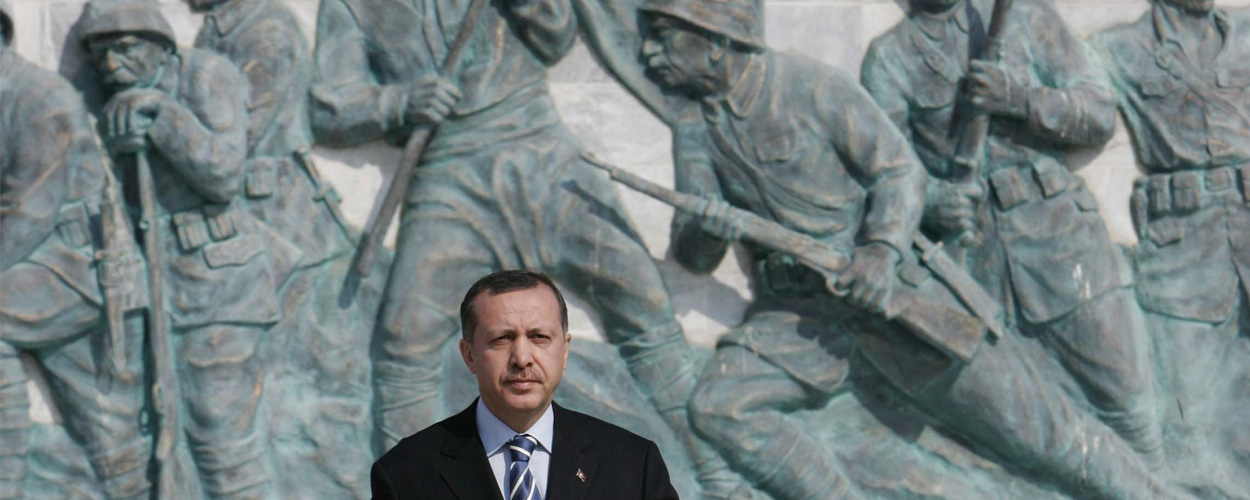
President Erdogan

Turkey may have stepped into its own ‘endless war’ in Syria

“The Turks have always pursued an unhappy policy in regard to native populations,” wrote German Gen. Erich Ludendorff of his World War I Ottoman allies. “They have gone on the principle of taking everything and giving nothing. Now they had to reckon with these people (Kurds, Armenians and Arab tribes) as their enemies.” The Turkish army, driven out of Syria after four centuries in 1918 by the British and “native populations,” is back. Turkish President Recep Tayyip Erdogan’s involvement in Syria reverses the policy of the republic’s first president, Mustafa Kemal Ataturk, that kept Turkey out of the Arab world. Ataturk looked westward and saw the futility of returning to lands that had rejected Turkish rule.

That arrangement worked for Turkey until 2011, when the uprising in Syria opened the way to foreign interference. The United States, the United Kingdom, France, Saudi Arabia, Qatar and the United Arab Emirates were backing assorted militias in their effort to depose Syrian President Bashar al Assad. Erdogan would not be left out. His border with Syria offered the most extensive terrain for infiltrating fighters and war materiel. Moreover, his Justice and Development Party had a long friendship with Syria’s Muslim Brotherhood, whose attempt to depose al Assad’s father, Hafez al Assad, in 1982 ended with the infamous massacre in Hama. Erdogan looked to the Muslim Brotherhood and its offshoots to play a leading role in the resistance to the younger al Assad. In 2012, a Syrian former Cabinet minister told me that Erdogan had asked al Assad to put Muslim Brothers into his Cabinet. When al Assad refused, the former minister said, Erdogan made clear that he would back all efforts to remove the president and replace him with Islamists…

Continue reading →
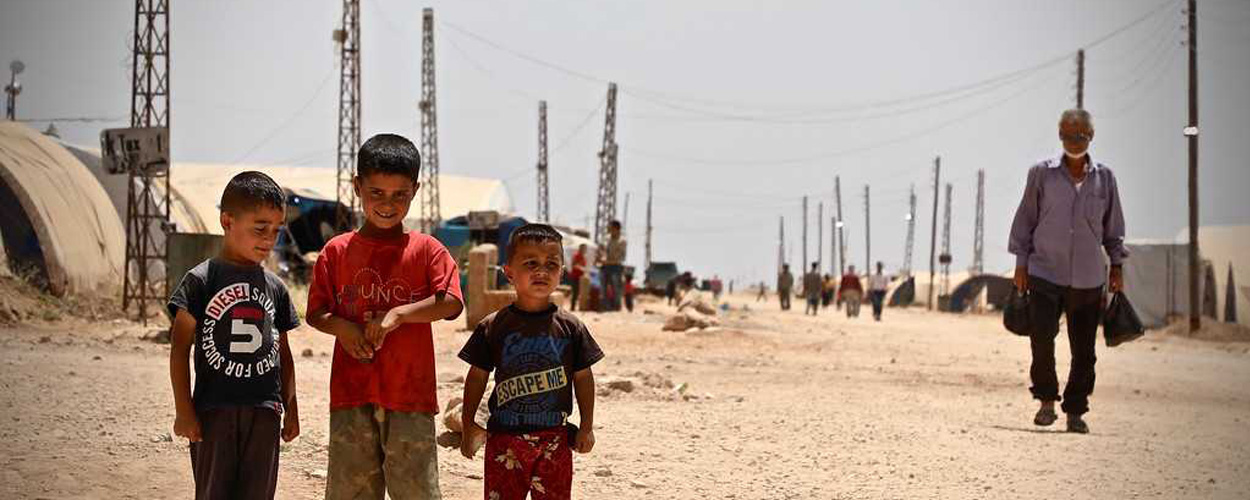
Children in Tal Serdam camp, Fafin, northern rural Aleppo.

The Syrian Civil War Grinds On, Largely Forgotten

While the United States and Iran risk all-out war with their game of chicken in the Persian Gulf, their proxy war is still playing out in Syria. Iranian ally and Syrian President Bashar al Assad won the war two years ago, but his victory was incomplete. Al Assad secured his throne, but two large swaths of the country remain beyond his reach. The Turkish army and rebel militants control the northwest. The mainly Kurdish Syrian Democratic Forces, supported by a small but unspecified number of U.S., British and French special forces, hold the area northeast of the Euphrates River near the Syria-Turkey-Iraq border triangle. Al Assad has said he will not give up the struggle until both areas revert to his dominion. The only other part of the country under foreign occupation is the Golan Heights, but al Assad is in no position to expel the Israelis.

Combat rages on the periphery of Idlib province in Syria’s northwest, where hundreds of civilians have lost their lives and as many as 300,000 have fled to relative, if uncomfortable, safety since the Syrian army launched its latest offensive two months ago. Rebel leaders told Reuters that Russian special forces were fighting alongside Syrian troops, although Russia has yet to comment on the allegation. What is known is that Russian warplanes from the Hmeimim air base have bombed towns in the rebel-held areas. On the rebel side, dependence on Turkish army protection, logistics, communications, ammunition and other supplies balances Russian help to al Assad. The Turks expelled the U.S.-backed Kurdish militia, the People’s Protection Units and Kurdish civilians from Afrin province near Idlib last year. That left a large zone abutting government-held areas around Aleppo, Hama and Latakia under Turkish occupation with local and foreign fighters to sustain pressure on al Assad’s forces…

Continue reading →
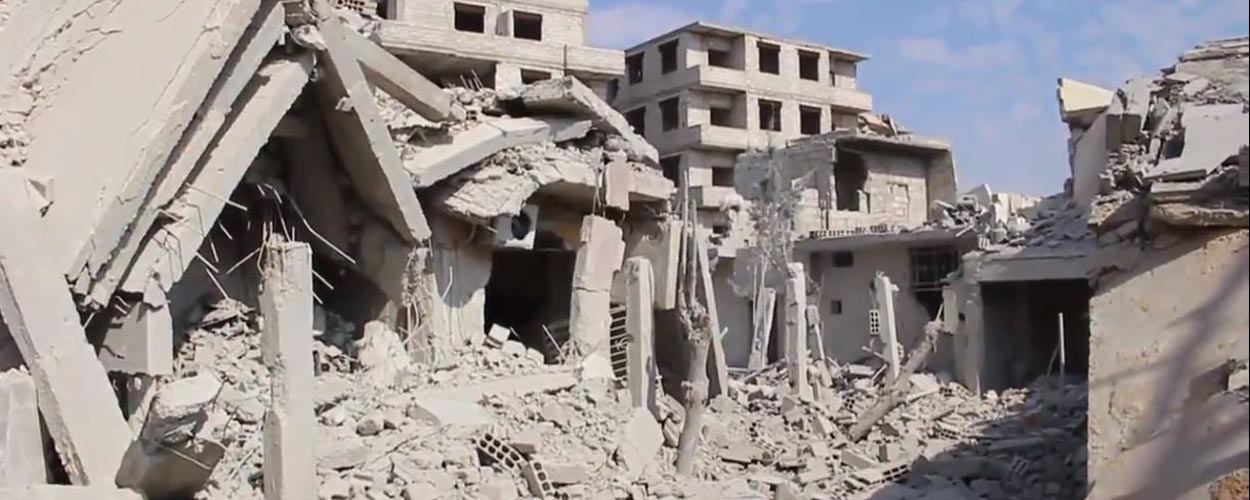
Ruins at Zamalka, Ghouta, Syria, 22nd Feb 2018

Tell me how this ends

In January 2017, following Donald Trump’s inauguration, his national security staffers entered their White House offices for the first time. One told me that when he searched for the previous administration’s Middle East policy files, the cupboard was bare. “There wasn’t an overarching strategy document for anywhere in the Middle East,” the senior official, who insisted on anonymity, told me in a coffee shop near the White House. “Not even on the ISIS campaign, so there wasn’t a cross-governmental game plan.”

Rob Malley, President Barack Obama’s senior Middle East adviser and Harvard Law School classmate, denied the charge. “That can’t be true,” the fifty-­five-­year-­old scholar insisted when we met in his office at the International Crisis Group in Washington. “We provided comprehensive memoranda to the incoming team, though we can’t know if they read them. We definitely had a long one on Syria, on all aspects of the conflict.”

I have observed the Syrian conflict off and on since it began, in 2011, filing stories from Damascus, Aleppo, Homs, Palmyra, the Turkish border, and other zones of contention. But the story as seen from inside Syria seemed as incomplete as the Trojan War without the gods. In the conflagration’s eighth year, I flew to the Olympian heights of Washington to ask the immortals what they were doing while an estimated half million of Syria’s twenty-­three million inhabitants were dying, millions more fled the country, and some of civilization’s most precious monuments were destroyed…

Continue reading →