Category Archives: First World War

The Great War, Library of Congress

Revisiting the Mental Health Fallout from the Unprecedented Horror of the First World War

All the armies in the Great War had a word for it: the Germans called it “Kriegsneurose”; the French “la confusion mentale de la guerre”; the British “neurasthenia” and, when Dr. Charles Samuel Myers introduced the soldiers’ slang into medical discourse in 1915, “shell shock.” Twenty-five years later, it was “battle fatigue.” By the end of the twentieth century, it became post-traumatic stress disorder (PTSD).

In December 1914, a mere five months into “the war to end war,” Britain’s armed forces lost 10 percent of all frontline officers and 4 percent of enlisted men, the “other ranks,” to “nervous and mental shock.” An editorial that month in the British medical journal The Lancet lamented “the frequency with which hysteria, traumatic and otherwise, is showing itself.”

Continue reading →
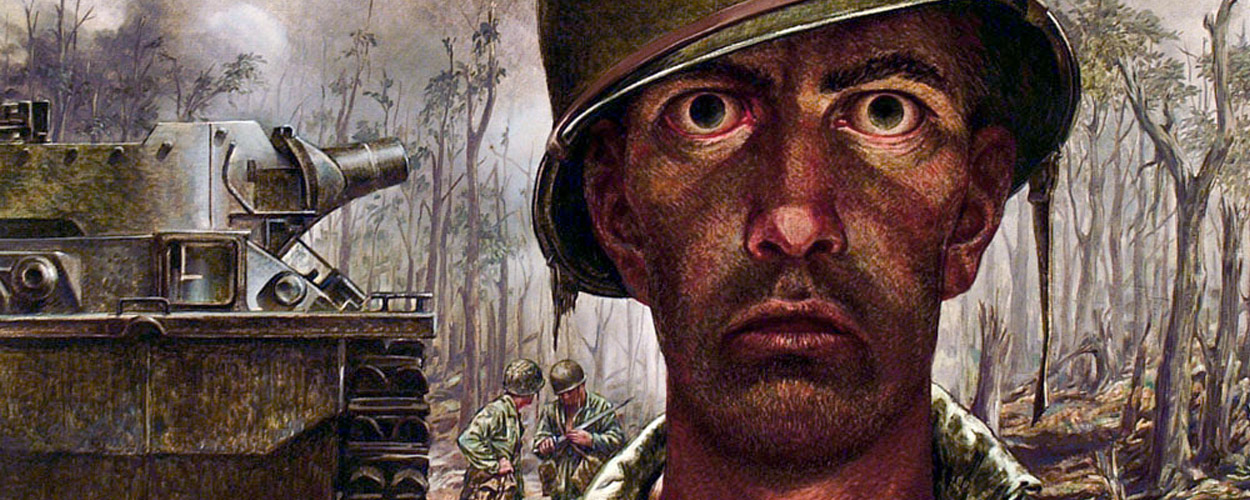
"The 2000 Yard Stare", by Thomas Lea, 1944, WWII. The Army Art Collection, U.S. Army Center for Military History

From “Shell Shock” to PTSD, Veterans Have a Long Walk to Health

Will Robinson, an American Iraq war veteran, languished for months with depression and post-traumatic stress disorder (PTSD) all alone at home in Louisiana. One day in March 2016, he watched the movie “Wild,” starring Reese Witherspoon as Cheryl Strayed. Strayed’s book of the same title told of her redemption from despair by hiking 2,650 miles of wilderness on the Pacific Coast Trail, from Mexico to Canada. Robinson decided to follow Strayed’s example, packing up a tent and supplies a month later to duplicate her journey and, he hoped, its hopeful outcome.

He had nothing to lose. Forced into the army at the age of eighteen by a judge who promised to erase his conviction for petty theft if he served, he was deployed to South Korea in 2001 and Iraq in 2003. Six months in Iraq left him with injuries to his wrist, his knee and, more significantly, his mind. The army gave him a medical discharge for PTSD, but it offered little in the way of medical treatment. He attempted suicide with drugs the Veterans Administration issued him, surviving only because the pills made him vomit. Other vets of the war on terror were not so lucky; every day, an average of twenty-two take their lives rather than endure another moment of living hell. Robinson promised his mother he would not try again. Then she died, and he retreated into loneliness and depression.

It was during that dark time that Robinson saw “Wild” and took his first, literal, step towards recovery. He may not have known that he was following the advice of a British psychiatrist, Dr. Arthur J. Brock, who had prescribed similar solutions to soldiers traumatized in the First World War. The battles between 1914 and 1918 subjected young men to the unprecedented terrors of high explosive artillery shells, poison gas, flamethrowers, rapid machine-gun fire and claustrophobia in rat-infested trenches. Growing numbers of casualties carried to field hospitals had no physical wounds. At least, not wounds the doctors could see.

Continue reading →
Soldiers Dont Go Mad

Poet by Day, Sick by Night

Every summer before the war, Siegfried Sassoon had gloried in playing cricket. Yet, at Craiglockhart, he shunned team sports and clubs. His only athletic pursuits were golf and leaping alone “like a young ram” over the Pentland ridges. At the end of his first week, he wrote to Ottoline Morrell, “My fellow-patients are 160 more or less dotty officers. A great many of them are degenerate looking.” One had committed suicide. Estranged from the other inmates, Sassoon cherished his time with [Dr. William Halse Rivers] Rivers, “a sensible man who doesn’t say anything silly.” Rivers assured him he was sane, albeit with one abnormality: opposition to the war. Yet, Sassoon wrote to Ottoline, the doctor’s pro-war arguments “don’t make any impression on me.”

He used the evening sessions with Rivers “to give my anti-war complex an airing.” Doctor and patient debated the war’s rights and wrongs, neither making headway with the other. Among discussion topics were European politicians’ declarations as translated in The Cambridge Magazine. Sassoon maintained the statesmen, far from waging defensive war, sought to annex territory from Germany and its allies. France wanted Alsace and the portions of Lorraine that Germany had seized in the 1870 Franco-Prussian War. The Kingdom of Italy had joined the war in April 1915 to acquire chunks of Austria-Hungary. Britain coveted German colonies in Africa. The May 1916 Sykes-Picot accord dividing the Ottoman Empire among France, Britain, and Russia would have bolstered Sassoon’s case had it not been an official secret. Rivers argued that Germany would not negotiate. Its military and political leaders were as determined as Britain’s to fight until victory, despite the stasis of the trenches, the daily death toll, and the calamitous offensives. Like the belligerent nations, Rivers and Sassoon stuck to their positions without breakthrough or compromise.

Continue reading →