Category Archives: iran

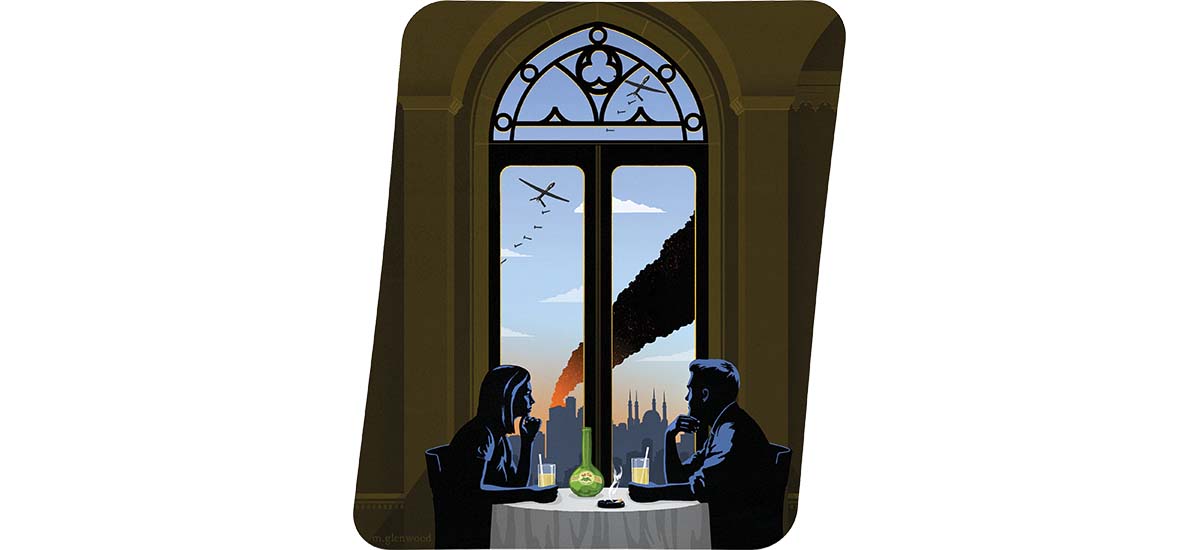
Illustration by M Glenwood for Alta

Letter from Beirut: A Stubborn Indifference to War

| 30th September 2026

This city keeps you on your toes, as long as you hang on to them. When you walk across a one-way street, look both ways. No driver—on a motorcycle or in an SUV—hesitates to charge the wrong way up a road clearly signed for traffic to go in the opposite direction. When two cars meet head-on, the driver going the wrong way shouts abuse at the innocent one obeying the rules. Welcome to Beirut.

This insouciant behavior reflects the near-unanimous contempt for law—in a country whose politicians illegally enrich themselves—of a populace with an indomitable will to enjoy life despite decades of violence. Since 1975, wars have caused unfathomable destruction while somehow allowing much of the city to survive. The ruination continues today courtesy of Israeli warplanes, rockets, and drones that demolish apartment complexes, mosques, hospitals, schools, and hotels.

“Do you remember what Lebanon was like before Iran and Hezbollah turned it into a nightmare?” Israeli prime minister Benjamin Netanyahu asked the Lebanese in a video message in June. “Remember the cafés? Remember the culture? Remember the calm? All that’s gone because Hezbollah and Iran want to drag us into war over and over and over again.” It’s easy to recall the cafés and the culture, though, because both are thriving. Even the so-called Hezbollah stronghold in Dahieh, in suburban southwest Beirut, comes alive between Israeli sorties, when residents rush to clear some of the wreckage and reopen cafés and shops.

Continue reading →
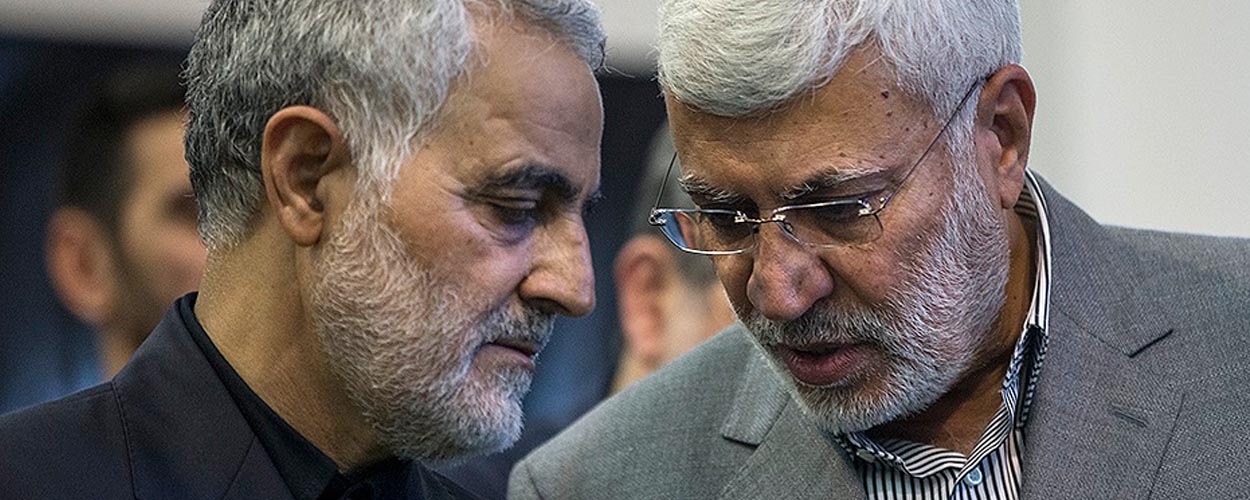
Abu Mahdi al-Muhandis at the funeral of Qasem Soleimani's father.

Reflections on the Life and Death of an Iraqi Militant

They buried Jamal Jaafar Ibrahimi in Najaf, Iraq, on Jan. 8. Although Ibrahimi was born far to the south in Basra province, Najaf was the chosen resting place for the reputed martyr. Najaf houses the Imam Ali mosque, an ancient and beautiful shrine in honor of Shiite Islam’s original martyr, Ali ibn Abi Talib, the Prophet Mohammed’s son-in-law. It attracts pilgrims from all over the Shiite world, many of whom in the future will no doubt be guided to Ibrahimi’s grave. The pilgrims will be reminded that American missiles killed the militia leader better known by his nom de guerre, Abu Mahdi al-Muhandis.

Al-Muhandis died in the early hours of Jan. 3 at Baghdad International Airport along with the man he had gone to greet, Iranian Maj. Gen. Qassem Soleimani, commander of the Islamic Revolutionary Guard Corps’ Quds Force. His assassination, perhaps more than Soleimani’s, increased local hostility to the U.S. presence in Iraq even among those opposed to Iranian interference in their domestic affairs. Unlike Soleimani, al-Muhandis was Iraqi, albeit with close familial and professional ties to Iran, and a government official. To Iraqis, the killing of al-Muhandis is equivalent to taking out Lt. Gen. Daniel Hokanson, director of the U.S. Army National Guard. The difference is that, while most Americans have never heard of Hokanson, every Iraqi knew about Abu Mahdi al-Muhandis…

Continue reading →

From the Somme to the Persian Gulf, Lessons on Shows of Force

When farmers in this part of Northern France plow their fields, they unearth relics of the war that ended here just over a century ago: shell casings, gas masks, skulls. The tranquil landscape, as flat as the plains of Kansas, belies the memory of the first day of the Battle of the Somme on July 1, 1916, when 21,000 British soldiers died charging across a few hundred yards of shell craters, weeds and barbed wire into German machine guns. That futile offensive raged until the following November, when death had claimed 1.5 million lives on both sides of the trenches. The war’s architects had not envisioned such slaughter when they mobilized young recruits in August 1914 on promises of an easy victory.

The historian Christopher Clark depicted the statesmen who led Europe into the Great War as men walking blind in their sleep through an open window. In his magnificent book, The Sleepwalkers: How Europe Went to War in 1914, Clark wrote, “The conflict that began that summer mobilized 65 million troops, claimed three empires, 20 million military and civilian deaths, and 21 million wounded.” That had not been the intention, any more than the treaty ending the war was supposed to produce another cataclysm 20 years later that would claim a further 60 million lives…

Continue reading →

World War Two’s Covert Ops Are Failing in the Post-War World

Before President Barack Obama authorized clandestine operations to defeat Syrian President Bashar al Assad in 2013, he asked the CIA to write the history of its secret wars. The classified document, say those who have read it, is a record of failure from Albania to Cuba to Angola to Nicaragua. Yet Obama went ahead with the covert program for Syria, which the CIA ran from Turkey and Jordan. Like its predecessors, Operation Timber Sycamore failed. It neither toppled Assad nor prevented Salafi jihadi fanatics from dominating the Syrian opposition. President Trump cancelled the program in July last year, but he is not immune to the siren call of another secret war – in his case, against Iran with as much chance of a positive outcome as Syria.

Why the fascination with arming foreign insurgents and proxy armies to fight wars that the US won’t fight itself? “We’re busily training, you know, local troops to fight local militants, why do we think we have this aptitude for creating armies?” Andrew Bacevich, a retired army colonel and author of America’s War for the Greater Middle East, once told me. “I don’t know. It sure as hell didn’t work in Vietnam.” Two reasons stand out. One is that, as Bacevich explained, insurgencies are wars “on the cheap,” not only in dollars but in assuring the public that American soldiers’ lives are not in danger. It is also a midway point between invasion and doing nothing. And most American presidents, faced with an opportunity to undermine rival states, want to do something.

Continue reading →