Tag Archives: Harper’s Magazine

Syrian president Hafez Assad declares war on Israel, October 6, 1973

Liberation Daze

Hope, fear, and uncertainty in postwar Syria.

When I first visited Syria, on Easter Sunday 1973, Christian families were attending Mass and calling on one another with presents of sugar-coated almonds. To this twenty-two-year-old graduate student hitchhiking to Aqaba from Beirut, Syria was a mix of delightful chaos and state-imposed monotony. Christians, Druze, Alawis, and Jews were free to practice their faiths. Unlike in Saudi Arabia, alcohol was legal. Women not only drove cars, they worked in offices, shops, and restaurants. Some chose to wear headscarves, but many chose not to.

At the same time, billboards reminded citizens of their duty to the Baath Party’s founding motto: unity, freedom, socialism. Children wore military-style uniforms at school, and informants spied on their neighbors. The image of Hafez al-Assad, who had been president for just over two years, was ubiquitous. When I visited Damascus some months later, protesters threw eggs at a foreign dignitary. I asked my philosophy tutor at the American University back in Beirut whether he thought the Syrian government approved. “If the Baath Party doesn’t want people to throw eggs,” he said, “the chickens don’t lay eggs.”

That was the Syria I came to know over fifty years, through wars, attempted coups, the death of Hafez, and the accession of his son Bashar. It seemed unchanging, unchangeable, even throughout fourteen years of civil war. And then, on December 8 last year, it all changed. Assad was gone…

Continue reading →
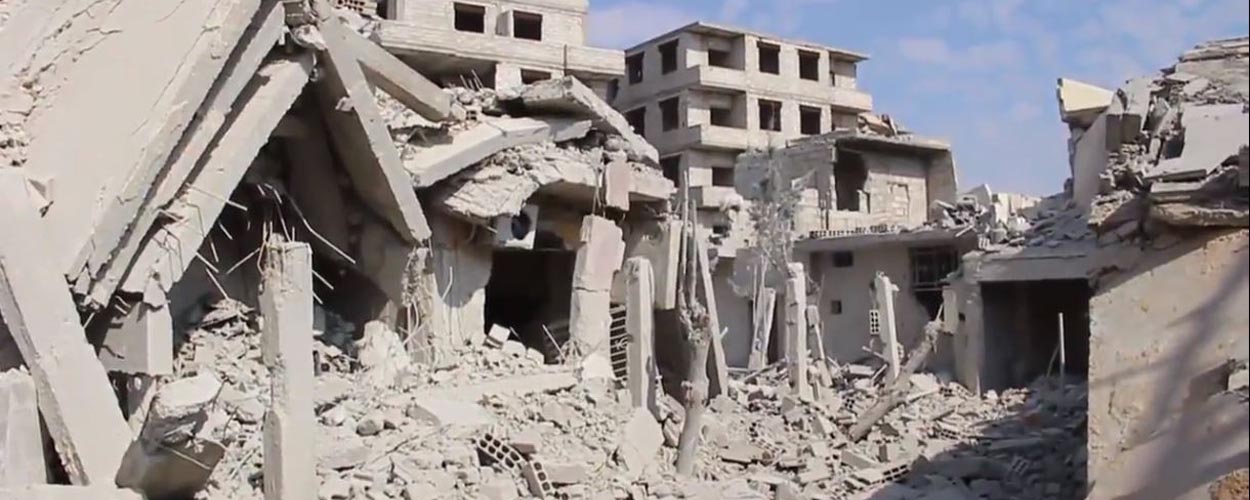
Ruins at Zamalka, Ghouta, Syria, 22nd Feb 2018

Tell me how this ends

In January 2017, following Donald Trump’s inauguration, his national security staffers entered their White House offices for the first time. One told me that when he searched for the previous administration’s Middle East policy files, the cupboard was bare. “There wasn’t an overarching strategy document for anywhere in the Middle East,” the senior official, who insisted on anonymity, told me in a coffee shop near the White House. “Not even on the ISIS campaign, so there wasn’t a cross-governmental game plan.”

Rob Malley, President Barack Obama’s senior Middle East adviser and Harvard Law School classmate, denied the charge. “That can’t be true,” the fifty-­five-­year-­old scholar insisted when we met in his office at the International Crisis Group in Washington. “We provided comprehensive memoranda to the incoming team, though we can’t know if they read them. We definitely had a long one on Syria, on all aspects of the conflict.”

I have observed the Syrian conflict off and on since it began, in 2011, filing stories from Damascus, Aleppo, Homs, Palmyra, the Turkish border, and other zones of contention. But the story as seen from inside Syria seemed as incomplete as the Trojan War without the gods. In the conflagration’s eighth year, I flew to the Olympian heights of Washington to ask the immortals what they were doing while an estimated half million of Syria’s twenty-­three million inhabitants were dying, millions more fled the country, and some of civilization’s most precious monuments were destroyed…

Continue reading →

All the Last Wars: around the world with the Goya of conflict photography

There were no civilian cars on the streets of Mosul, Iraq, last December, when the veteran war photographer Don McCullin and I hitched a ride in an Iraqi Army pickup. A few children smiled and flashed V signs at us, but the adults’ stares betrayed hostility or, at best, caution. If Islamic State fighters returned, anyone seen consorting with the army would be punished.

The soldiers took us to an abandoned house in Hay Tahrir (“Liberation Quarter”), a working-class neighborhood in the northeast. Islamic State fighters had only recently been expelled from the area. A blanket was tacked up over the doorway, and daylight came in through the mortar holes in the walls. We dropped onto the dirty floor, folding our legs bedouin-style. The soldiers offered us tea, which had been brewing on a gas burner.

The Iraqis asked McCullin how old he was. Eighty-one, he said. Did he have children? Four boys and a girl. One soldier asked permission to marry his daughter. McCullin told him he couldn’t afford the dowry. After more banter, the soldiers agreed to let us stay the night and go with them to the front in the morning.

A few minutes later, an Iraqi Army Humvee screeched up to the building, and an officer ordered us to accompany him to a forward command post. The brass had discovered that we were in town without permission. Just a month earlier, the Iraqi Army had been welcoming journalists, boasting of victories against the militants, but there was no boasting now. It was the wrong time to be covering the Battle of Mosul.

Continue reading →