To see the consequences of war, come to Homs. Known to the Romans as Emesa, Syria’s third-largest city is only…
Continue reading →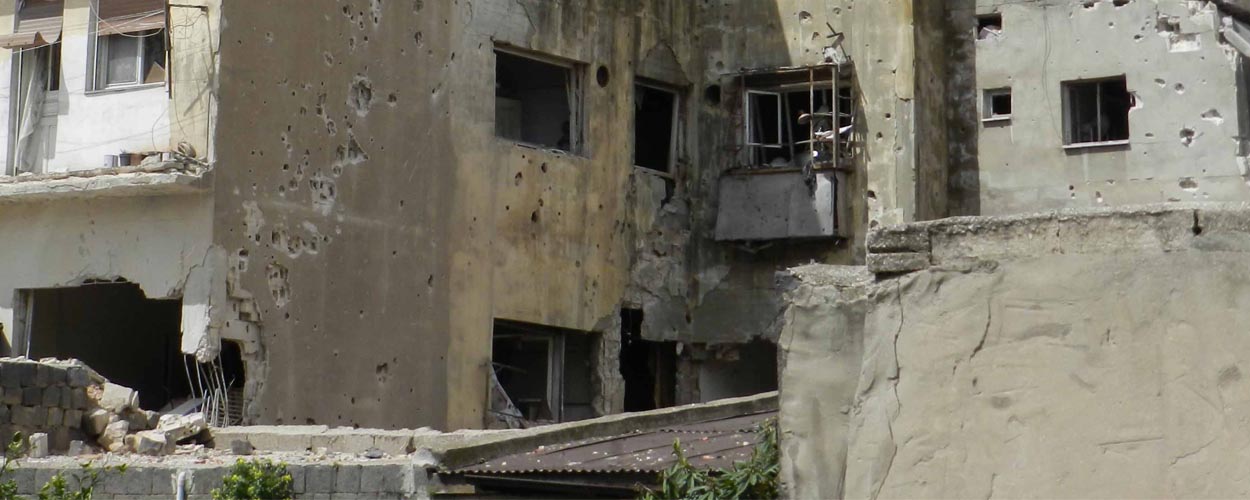

Join the mailing list to receive details of new articles and upcoming events
To see the consequences of war, come to Homs. Known to the Romans as Emesa, Syria’s third-largest city is only…
Continue reading →
Salahuddin Khan Mehsud is one tough cop. He has to be, working in Pakistan’s Khyber-Pakhtunkhwa province, a tribal region that the U.S. government calls a lawless hotbed of jihadist terrorism. Yet he assured me when we met recently in the town of Kohat that the province had “not had one major incident of terrorism” this year. That was no small achievement, but Mehsud spoke too soon. On the night of Dec. 1, just a week after our meeting, Pakistani Taliban militants staged a massive terrorist attack in the provincial capital, Peshawar. Assailants disguised as women in face-covering burkas broke into the Agricultural Training Institute. By the time police and army commandos gunned the terrorists down, nine students were dead and 18 had suffered bullet wounds. Only the fact that most undergraduates were away celebrating Eid-e-Milad, the Prophet Muhammad’s birthday, prevented a higher death toll.
The attack was the area’s worst terrorist incident since 2014, when militants killed 132 children and nine adults at a primary school in Peshawar. Outrage over the children’s deaths proved to be, in the words of Pakistani BBC analyst Aamer Ahmed Khan, “a watershed for a country long accused by the world of treating terrorists as assets.” The newly elected provincial government, under a reformist party called Pakistan Tehreek-e-Insaf (PTI), or “Movement for Justice,” struck back. It did not use drones or massive assaults to deal with the crime. Instead, it used old-fashioned police work.
Continue reading →
Once upon a time here in Dhaka, Bangladesh, this teeming city on the Buriganga River, the bells of the Holy Resurrection Church echoed for miles. Armenians built their house of Orthodox Christian worship amid the palm groves in 1781, almost two centuries after Persian Shah Abbas the Great conquered eastern Armenia and thousands of them migrated to Bengal. They and their progeny prospered as traders in jute, silk and leather. In 1880, the church clock stopped ticking, perhaps because of rust from the tropical damp, and the bells rang no more. Despite that ill omen, the Armenians of Dhaka were among the lucky few of their compatriots spared the Ottoman Turks’ genocide during World War I.
Yet genocide is no stranger to Bangladesh, known from 1947 to 1971 as East Pakistan. More than a million Bangladeshis died during the India-Pakistan War of 1971, when West Pakistani soldiers raped tens of thousands of Bangladeshi women and sent millions of refugees fleeing to India for safety. After Pakistan conceded Bangladesh’s independence, the Bangladeshis themselves proved susceptible to the genocidal urge, slaughtering Muslim Biharis and Buddhist Chakmas.
Now, nearly 50 years later, genocide haunts the country again. This time, the Bangladeshis are neither victims nor perpetrators. They are witnesses who have provided haven to more than 620,000 survivors of the mass executions, expulsions and rapes that Myanmar’s army and Buddhist paramilitaries have committed since last August. What baffles people here in Dhaka is that the United Nations, the United States, the European Union and other preachers of international morality refrain from labeling the killings and expulsions as genocide. Important visitors to Myanmar, including Pope Francis just this week, shy away from so much as referring to the victims by the name they use to describe themselves — Rohingyas — lest they upset the country’s military and jeopardize its fragile transition to democracy. The Burmese ruling class denies the Rohingyas’ existence as a people.
Continue reading →Syrian President Bashar al Assad must have taken a lesson or two from the master American politician, late Chicago Mayor Richard J. Daley. When Chicago police beat and abused young anti-war demonstrators during the Democratic National Convention in 1968, the party establishment turned against the Windy City’s leading official, just as in 2011 much of the world condemned al Assad’s treatment of anti-government protesters. Liberals called Daley a fascist then; later, U.S. politicians labeled al Assad a tyrant.
Many Democrats called for Daley’s resignation in 1968, but Chicago voters gave “Hizzoner” an unprecedented fifth term in April 1971 by a majority of 70 percent. At a press conference the next day, one journalist reminded Daley about the leading Democrats who had condemned him in 1968 — Ted Kennedy, George McGovern, Hubert Humphrey and Edmund Muskie, among others. The reporter then asked, as legendary Chicago newspaperman Mike Royko wrote in his biography of Daley, “Have any of them telephoned with congratulations?”
Daley smiled and answered, “All of them did.”
Continue reading →The result of Iraqi Kurdistan’s independence referendum was never in doubt, but the budding state’s future is. Of the 72 percent of registered voters who turned up at the polls, a little more than 93 percent opted to separate their homeland from Iraq. Independence, however, is fraught with the dangers of disputed borders, ferocious opposition from its neighbors and internal dissent.
As a longtime “friend of the Kurds” who made his first illegal attempt to enter Iraqi Kurdistan from Iran in 1974 with ABC News’ Peter Jennings but succeeded many times thereafter, I want to see them free and secure. More than that, my wish is to see them avoid the destruction and displacement of the kind that Saddam Hussein inflicted on them in 1975, 1988 and 1991, when the United States abandoned them to their fate. Their leaders would be well advised to proceed with caution. The Iraqi Kurds’ antagonistic leaders are Massoud Barzani in Arbil and Hero Ibrahim Ahmad, a formidable woman who acts as a kind of regent while her husband, former Iraqi President Jalal Talabani, languishes in a semi-coma. The Barzanis and Talabanis, though rivals, guided their people through the dark years of genocide by the Iraqi government and brought them to the semi-independent status they enjoy today. For that, they deserve our respect. They probably do not deserve my advice, but I’ll offer it anyway…
Continue reading →When rulers seek unslayable dragons to destroy, they should remember Elba. This tranquil, idyllic isle off the coast of Tuscany was, from May 1814 to April 1815, home to Napoleon Bonaparte. The British and their allies had exiled him there, leaving him to govern the island’s 12,000 souls. The emperor, a title he was allowed to keep, enjoyed two splendid houses, a magnificent library, servants, a small army and the company of family and retainers. This was a life for a king, but small recompense for a man who sought to rule the world.
Rather than write memoirs of one of history’s greatest dramas, Napoleon escaped. But, wrote biographer Philip Dwyer, “Napoleon left Elba not to save France, but to save himself from oblivion.” As we now know, his decision to resume the fight against Britain proved to be a mistake. His country’s humiliation followed at Waterloo, leaving thousands of his countrymen and their opponents dead or mutilated and forcing him to abdicate again. He ended his days, not in the congenial splendor of Elba, but on another island, Saint Helena, in the icy waters of the south Atlantic. He died there in 1821.
As I explored the grounds of Napoleon’s Palazzina dei Mulini, I thought of U.S. President Donald Trump’s recent decision to send another 4,000 American troops to Afghanistan. The United States’ battles began there in 2001, ostensibly with the limited objective of removing Osama bin Laden and his al Qaeda followers from the country. That was 16 years ago. Sending more soldiers to risk their lives in the South Asian quagmire would make sense if Trump’s strategy differed from the doomed policies of the past. But it doesn’t…
Continue reading →When I lived in rural Ireland years ago, a favorite joke started with an American tourist stopping a local farmer and asking for directions to Cork. The farmer pondered a moment before answering, “Well, if I was you, I wouldn’t be going there from here.” Anyone advising Washington on where to go in Syria has little choice but to admit that he’s as bewildered as that tourist in the Emerald Isle.
One place to start, though, is Lebanon. For the past week, Lebanese Shiite militia Hezbollah has been fighting to remove jihadists belonging to the Islamic State and the former Jabhat al-Nusra from the Syrian side of the border. Within Lebanon, the army, with British assistance, has sealed the border against incursions of the kind witnessed in 2014 when the Islamic State captured the largely Sunni village of Arsal and kidnapped more than 20 Lebanese soldiers and policemen. This month, the Lebanese army and, over the border, the allied forces of Hezbollah and the Syrian military have caught the jihadists in a pincer. Whether or not the Lebanese and Syrian armies colluded in the venture, it appears to be removing the jihadists from the region…
Continue reading →Flying into the United Kingdom after five months away was like arriving in a parallel universe. Syria, where I’d been covering a war in which the United States and Russia are playing chicken, seemed static in comparison. Tectonic plates are shifting. Strong winds are blowing. Lightning is exposing a beleaguered landscape while wary citizens await the thunder’s rumble. The Royal Ascot races have permitted men to remove their jackets in the heat. The speaker of the House of Commons declared that male members need not wear neckties. A crowd of thousands at a music festival cheered the Marxist leader of the Labour Party, Jeremy Corbyn, as if he were Mick Jagger. Was it only a year ago that an unbeatable Conservative government was on course to balance the budget and stay in the European Union?
A populist tide is rising, as it did in the United States during last year’s presidential race, but from the left this time. It’s engaging youngsters who are fed up with student debt, privatized trains that don’t work, backhanders for the backroom boys and the impossibility of buying the kinds of houses their parents had. There’s a generational divide between young people who want the United Kingdom to remain in Europe, giving them the right to live and work anywhere in the bloc, and a gerontocracy that imagines a post-Europe Britain recapturing the island’s imperial glory.
Continue reading →Blue cloth, stretched like the fabric in which Christo enfolded Berlin’s Reichstag, swaddles a six-story building in central Damascus. Inside,…
Continue reading →At a sumptuous lunch in Beirut, my friends were debating whether Israel would invade Lebanon. One, a member of parliament,…
Continue reading →