Tag Archives: The Nation

Hadja Lahbib and Ahmed al-Sharaa

Syria’s New Rulers Get a Makeover

The messages started appearing on my phone as soon as I left Syria in mid-January. At first, there were links to articles, and social media posts, about threats to Alawis and Christians. Then came friends’ accounts of scary incidents. One woman wrote that a police officer from the new government ordered her to cover her hair. Another told me a Sunni friend – a friend – threatened to kill her. A Christian businessman I’ve known for years texted that he would no longer send me anything political via WhatsApp, because the new government was watching.

The atmosphere was already changing from what I had observed at the beginning of the Hayat Tahrir al-Sham (HTS) government under its leader, Ahmed al-Shara. Shara had dropped his nom de guerre, Abu Mohammad al-Jolani, along with the battle fatigues from his years leading Sunni Muslim fundamentalists against the regime of Bashar al-Assad. With a trimmed beard and a new suit, he was receiving and visiting fellow heads of state from the Middle East and beyond. An American delegation was so impressed that the US revoked its $10 million bounty on Shara’s head for terrorist crimes.

Continue reading →
Beirut bombing 2024

Beirut Gets a Reprieve—but for How Long?

If history is any guide, the latest Lebanese ceasefire may well have broken down by the time you read this.

Whenever I hear the word “ceasefire” about Lebanon, I reach for my stopwatch. During the first phase of the civil war there, in 1975–76, we would give numbers to each successive ceasefire. Our tally ran out of steam after 100.

Each time, something—a Christian boy dating a Muslim boy’s sister, a car theft, a drug deal gone wrong, flying a party flag in the wrong neighborhood—would kick-start a fresh wave of violence. One of Beirut’s early front lines was a street between Christian and Muslim neighborhoods. Western journalists—of whom I, as a young stringer for various publications and radio networks, was barely one—left the St. George Hotel bar long enough to observe exchanges of fire, pick up a few quotes, gather some color, and file in time for dinner. Then we would wait for the next ceasefire.

The fighting escalated with the introduction of artillery and snipers, whose favored targets seemed to be women and children. There was a period when the violence paused at the end of each month. It took us a while to realize why: It was payday for the militiamen, who held their fire long enough for the banks to reopen. Checks cashed, they started firing again. I am not making this up.

Lebanon’s war has taken many forms since then: Israel against the Palestine Liberation Organization; Maronites against other Maronites; Maronites versus Druze; a faction of the Lebanese Army against the Syrian Army; the Shiite Amal militia against the Palestinians; Israel versus Syria; and the recurring conflict between Israel and Hezbollah. The one constant is the ceasefire: a false promise of peace that gives the belligerents a chance to regroup and rearm.

Continue reading →
IDF ground maneuver to Lebanon, 2024

In Lebanon, Israel Is Only Sowing the Seeds of More Bloodshed and Terror

The history of Israel’s incursions into Lebanon are a series of lessons in futility and the arrogance of power. If only anyone were paying attention.

The Kamal Adwan Hospital in northern Gaza is appealing for fuel to run its generators amid a siege and evacuation order by the Israeli military that threatens the lives of its patients, including more than a dozen children in the Intensive Care Unit. At the southern end of the Strip, the Mohammed Yusuf al-Najjar Hospital was forced to cease operating by Israeli military pressure—depriving Gaza of its only kidney dialysis unit. Elimination of hospitals has become a normal aspect of what the United Nations calls Israel’s “concerted policy to destroy Gaza’s healthcare system.” It is worth reflecting not only on the two hospitals’ fates but also on their names: Kamal Adwan and Mohammad Yusuf al-Najjar. They tie Gaza to Lebanon, where I was living on the night both of them were murdered.

Continue reading →

If Joe Biden Really Wants to Celebrate Press Freedom, He Should Free Julian Assange

Joe Biden will celebrate World Press Freedom Day tomorrow. But it is a safe bet that he’ll have nothing to say about Assange or Imran Khan, both behind bars for defying the US.

President Joe Biden’s eloquence, such as it is, soars highest when he hymns alleluias to the free press. “Courageous journalists around the world have shown time and again that they will not be silenced or intimidated,” he proclaimed last year on the occasion of World Press Freedom Day. “The United States sees them and stands with them.” He reprised the theme last week at the White House Correspondents Association Dinner: “There are some who call you the enemy of the people. That’s wrong and that’s dangerous. You literally risk your lives doing your job.” The assembled correspondents, although themselves confronting no risk greater than crossing Pennsylvania Avenue to rewrite press secretary Karine Jean-Pierre’s handouts, applauded their stalwart champion.

The administration’s commitment to freedom of the press is rivaled only by its devotion to democracy beyond America’s borders. The public need not wait until 15 September — International Democracy Day — for the State Department to support fair elections in, say, Pakistan. Donald Lu, assistant secretary of state for South and Central Asian affairs, shared his concern for Pakistani electoral integrity in testimony to a House subcommittee on March 20. Lu, referring to February’s contested results, stated, “We have never used the term ‘free and fair’ in the characterization of this election.” Lu mentioned, among other deviations from democratic norms, “mass arrests of those in opposition, the shutdown of internet, and censorship and pressure placed on journalists.”

To the world’s journalists and Pakistan’s voters, the message is clear: America has your back. American actions, however, send a message at odds with Biden’s and Lu’s rhetorical flourishes: Don’t mess with Uncle Sam. Those who do will end up like Julian Assange in London’s Belmarsh Maximum Security Prison and Imran Khan in Rawalpindi’s Adiala Jail…

Continue reading →
Demonstration for Julian Assange, Barcelona Feb 20, 2024

The US Government’s Plot to Murder Julian Assange

While dictators kill troublesome journalists with guns and missiles, democracies can afford to be more patient. But the end result is the same.

In most of the countries whose wars I’ve covered over the past 50 years, journalists were fair game. The first deliberate killing I remember took place during Lebanon’s civil war in May 1976, when a sniper shot Le Monde correspondent Edouard Saab. Saab, who also edited Beirut’s French language daily, L’Orient-Le Jour, had excoriated the Syrian regime for stoking Lebanon’s violence … The Syrians were not the only ones killing writers in Lebanon. In 1966, supporters of Egyptian President Gamal Abdel Nasser murdered Kamal Mrowe, the esteemed editor-publisher of the Arabic daily Al Hayat. Mossad killed Palestinian writer Ghassan Kanafani in Beirut in July 1972, two months before I moved there … That’s just the Middle East. In other regions where I’ve worked soldiers and politicians murdered journalists with impunity. There is barely a corner of the globe where reporters are not targets of the powerful forces they challenge. The United States presents itself as an exception, despite its toleration of friendly states, like Saudi Arabia and Israel, that have killed journalists. On World Press Freedom Day, May 3, last year, President Joe Biden declared, “Courageous journalists around the world have shown time and again that they will not be silenced or intimidated. The United States sees them and stands with them.”

America did not stand with the reporters and camera operators from Al Jazeera, Reuters, and Spain’s Telecino in Baghdad when US forces fired on and killed them on April 8, 2003. The case that the killings were unintentional wore thinner in July 2007, when a US Apache helicopter killed a group of unarmed civilians on the streets of Baghdad. Among the dead were Reuters journalists Namir Noor-Eldeen and Saeed Chmagh. Only WikiLeaks’ publication of the “Collateral Murder” footage, complete with the crew’s voiced glee at the killings, exposed the official lie.

Continue reading →
Medic carrying wounded Palestinian child in Gaza, 17th October 2023

Aren’t the Children of Gaza Worth Saving?

If our answer is yes, then we have to stop sending Israel the weapons that kill them. No one turns his back on a child whose life is threatened. This is how it should be. Who turns away from a child in danger? Why then the silence on the children killed, maimed, buried alive and orphaned in Gaza since the 8th of October last year?

Continue reading →
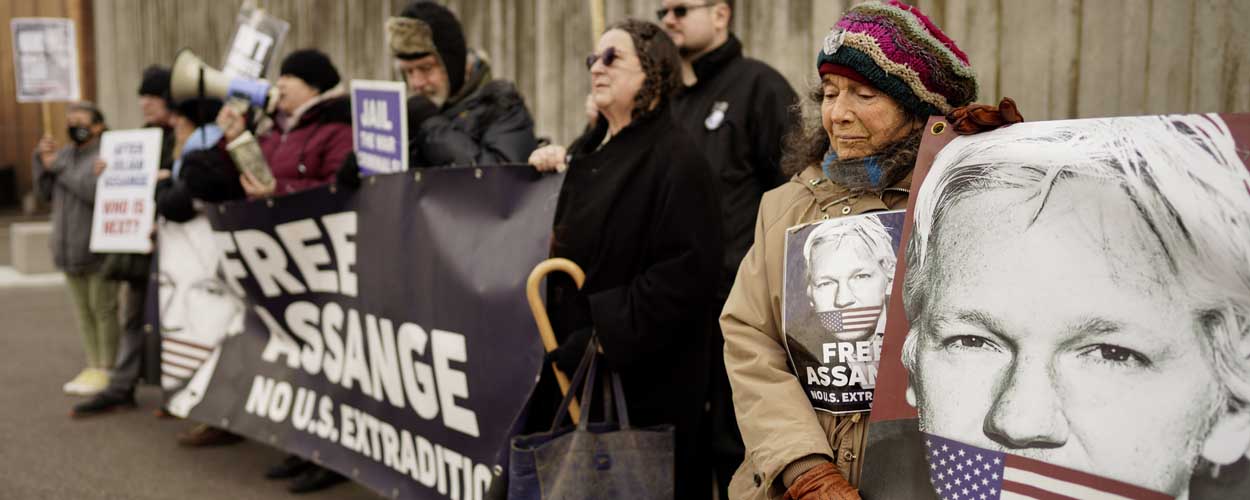
Protest in solidarity with Julian Assange outside the walls of Belmarsh Prison

A Visit to Belmarsh Prison, Where Julian Assange Awaits His Final Appeal Against Extradition to the US

HMP Belmarsh. It is 2:30 pm on Wednesday, December 13, when Julian Assange strides into the visitors’ area. He stands out in the column of 23 prisoners for his height — 6′ 2″ — and flowing white locks with trimmed beard. He squints, looking for a familiar face among the wives, sisters, sons, and fathers of the other inmates. I am waiting, as assigned, at D-3, one of about 40 sets of small coffee tables surrounded by three upholstered chairs — two blue, one red — screwed into the floor of what looks like a basketball court. We spot each other, walk forward, and embrace. It is the first time I have seen him in six years. I blurt, “You’re pale.” Through a mischievous smile I remember from past meetings, he jokes, “They call it prison pale.”

He has not been outdoors — apart from a minute when police dragged him into a paddy wagon — since he took refuge in London’s cramped Ecuadorian Embassy in June 2012. The embassy’s French windows had afforded glimpses of sky. Here at Belmarsh maximum security prison in southeast London, his abode since April 11, 2019, he has not seen the sun. Warders confine him to a cell for 23 out of every 24 hours. His single hour of recreation takes place within four walls, under supervision. His paleness is best described as deathly.

Continue reading →

Ruling Assange Can’t Be Extradited Is an Indictment of US Prisons

But the British court judgment, which is likely to be appealed, also delivers a body blow to freedom of speech.

My junior year high school English teacher liked to tell a story about Henry David Thoreau and Ralph Waldo Emerson to illustrate the differences between America’s two great transcendentalist writers. Thoreau was jailed in 1846 for withholding taxes that paid for the invasion of Mexico and protected slave owners. Emerson came to speak to Thoreau through the bars of his cell. My teacher, with theatrical flair and stentorian voice, recounted the conversation:

‘Emerson: “What are you doing in there, Henry David?”
Thoreau: “The question is, what are you doing out there, Ralph Waldo?”’

We might ask ourselves what we are doing out here while Julian Assange remains “in there” at Belmarsh Maximum Security Prison in London…

Read Julian Assange In His Own Words

Continue reading →
Penn, Zenger, Assange

If Assange’s Fate Were Up To a Jury, He, Too, Might Have Walked Free

Like William Penn and John Peter Zenger, the Wikileaks founder is fighting for our freedom.

When the magistrate presiding last September at Julian Assange’s extradition hearing, Vanessa Baraitser, confined the defendant to a bullet-proof glass cage at the back of the court, she had precedent on her side. All who entered her courtroom at London’s Central Criminal Court, the Old Bailey, had to pass a plaque memorializing a case against another defender of free speech and thought…

Continue reading →
Julian Assange

Free Julian Assange!

By depriving the WikiLeaks founder of his freedom, prosecutors in the US and Britain are intimidating journalists—and abetting torturers, war criminals, and kleptocrats everywhere.

If WikiLeaks did not exist, the public would know much less than it does about what government and politicians are doing in its name.

When a 35-year-old Australian named Julian Assange launched WikiLeaks with a few like-minded friends in 2006, he little knew what exposing malfeasance would cost him. The WikiLeaks model was simple: provide a safe repository for documents showing state and corporate wrongdoing while guaranteeing anonymity for the leaker. Newspapers were not necessarily safe for whistle-blowers, as British civil servant Sarah Tisdall discovered in 1983 when London’s The Guardian caved in to a court order and handed over documents that identified her as the source for its story on US cruise missile deployment in the UK. She went to prison for four months and lost her job…

Continue reading →